
In my younger years I was, without realizing it at the time, a very anxious person. My anxiety manifested as out of control worry about anything in my life that was unresolved. If a problem came up, I couldn’t stop my mind from trying to work through every possible cause, and every possible solution. More than that, I couldn’t rest or relax until I found out the answer. I could not let things go. The worst thing someone could say to me was, “we need to talk.” That phrase would send my anxiety through the roof as systematically analyzed every conversation and interaction I’d had with them, as well as everything that had nothing to do with them which somehow they might have discovered and might have had some detrimental affect on our relationship. I drove myself crazy with worry, and drove others crazy badgering them to try and tell me what the problem was so I could try to “fix” it.
Through years of practicing Tai Chi I found a way to stop (or at least, reduce) that; I’m no longer that person. I achieved that by learning and understanding the concept of doing nothing.
The theory and philosophy of Tai Chi is grounded in Taoist philosophy. A fundamental concept of Taoism is the phrase: “wu wei, wu bu wei“. It translates to, “do nothing, do not nothing (ie: do everything)”, or as its often paraphrased, “do nothing and leave nothing undone.” Whilst on the surface this might seem contradictory, its really about finding a balance within oneself: knowing when to act, and when to do nothing; or, knowing when to stop, and when to go. In Taoist thought, this is allowing ourselves to follow Nature or the Natural Way. The idea is that our bodies know when we are ready to work, and when we need to rest; when we need to eat, and when we need to digest; when we need to be awake, and when we need to sleep. The demands we place on ourselves disrupt that balance: we overwork, we eat too much or not enough, or lose sleep because other things demand we stay awake. In my case, it was an out of control need to resolve an issue that I might not (most likely did not) actually have any control over.
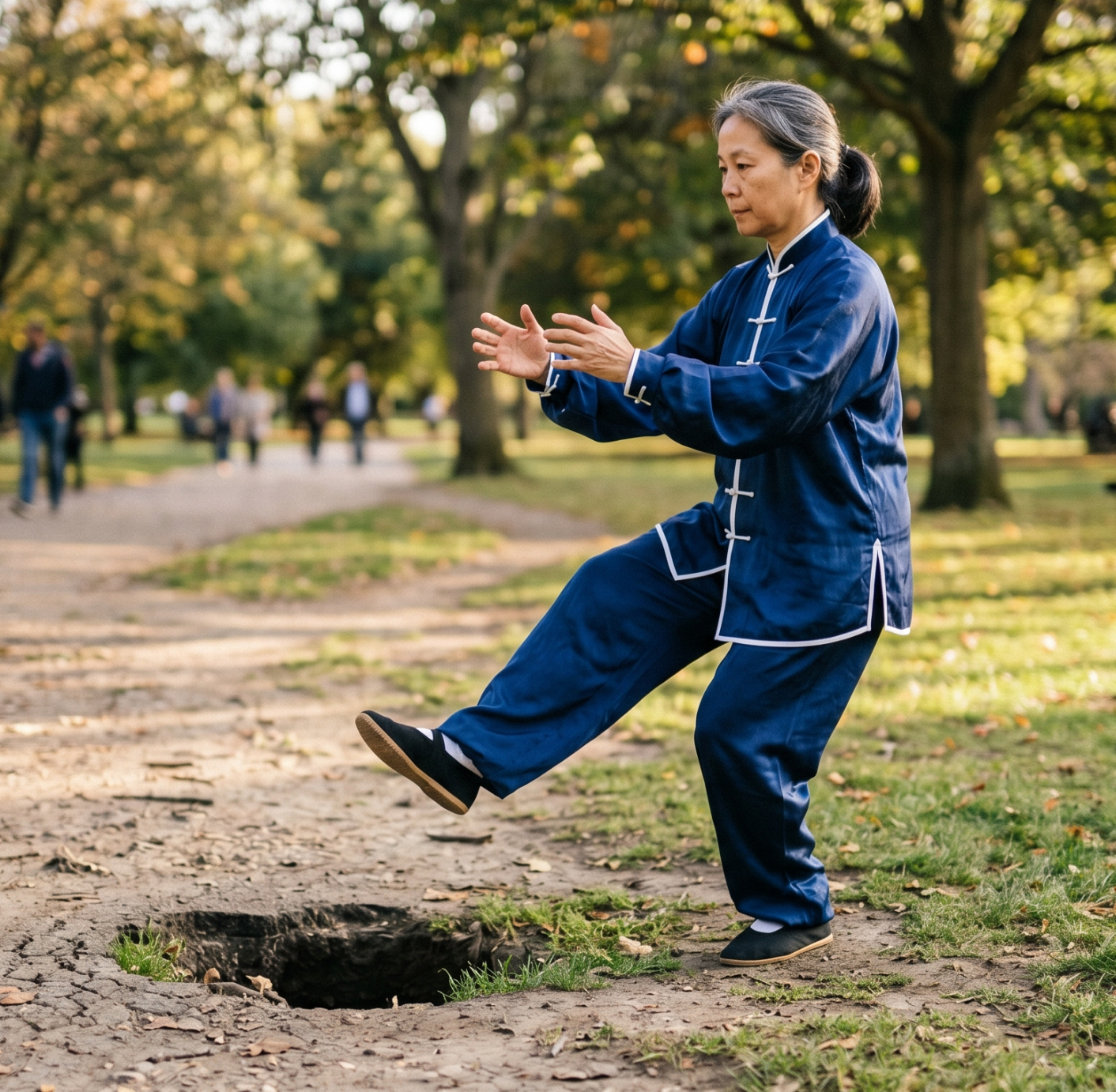
In Tai Chi there is a fundamental technique called Tai Chi walking (miao xing). Part of this technique involves learning how to take an “empty step”. In simplest terms, the idea of an empty step is to advance the leg you’re stepping forward with and just touch the heel to the ground with no weight in it. When you decide to commit to taking the step, you shift your weight forward and only then does the rest of your foot come down and you take your weight through that leg. For those unfamiliar, you can think of it like dipping your toe into bath or a lake to check the temperature before taking the plunge: you want to be sure of the temperature before you commit the rest of your body to it. Inherent in that idea is that you can decide not to proceed with entering the water. In the same vein, the empty step in Tai Chi walking allows the practitioner to also change their mind and, for example, redirect their step, or perform a different action altogether, because they have not yet committed to taking the step. In other words, you prepare for the step, and then “do nothing”. You wait to whether you’re going to proceed with that action or not. Once you’ve made your decision, you “do everything”: you take the step, or, you take a different course of action. Either way, it is a conscious and deliberate action, as opposed to an automatic action or reaction.
It took me many years, and a concerted effort on delving into the theory and philosophy of Tai Chi to make the connection between this Taoist philosophy and the physical actions of performing Tai Chi. Yet on some level, I believe I subconsciously made some kind of connection through practicing my Tai Chi. You could say making this connection was a requirement of being able to perform my Tai Chi more correctly, and when I consciously made the connection, it was to the benefit of both my Tai Chi and my own mental health.
What this has taught me, and what I now strive to do, is whenever something comes up, the first thing I do is stop (wu wei). That moment, even if extremely brief, enables me to ask myself two questions:
- is this something I need to focus on right now?
- is there anything I can do about this right now?
These questions are like taking an empty step: they allow me to determine what my next course of action will be, or for that matter, whether I even need to take a (different) course of action right at that moment.
If the answer to the first question is “yes”, then I can consciously divert my attention from whatever it is I’m doing and focus on the new issue. Otherwise, I can acknowledge the issue, yet remain focused on the task at hand, and allow myself to set aside the new issue for consideration at another, more appropriate, time.
Similarly, if the answer to the second question is “yes”, then I can assign whatever physical, mental and emotional resources I need to the new issue. If not, however, then I can accept that in this moment there is nothing I can do about it, and save that energy and effort for another time when I can do something about it (wu bu wei).
I’ll be the first to admit: for me at least, this is neither perfect nor foolproof. It has, however, brought more balance into my life, and subsequently how I interact with the world and with other people. I cannot say it takes away my worries altogether, however, it does help to ensure that those worries don’t overpower, overwhelm, or control me. I can remain focused on the task at hand, or I can even stop just to wait and see what unfolds, rather than trying to make it unfold. In this way, when it is time to do something, I can make better decisions about what to do or how to act, and even though the outcome might not always be in my favor, it will almost always be a better outcome than if I had simply reacted to it in the way I have in the past.
And unlike Franklin from my favorite childhood comic strip, I no longer waste a good worry.
